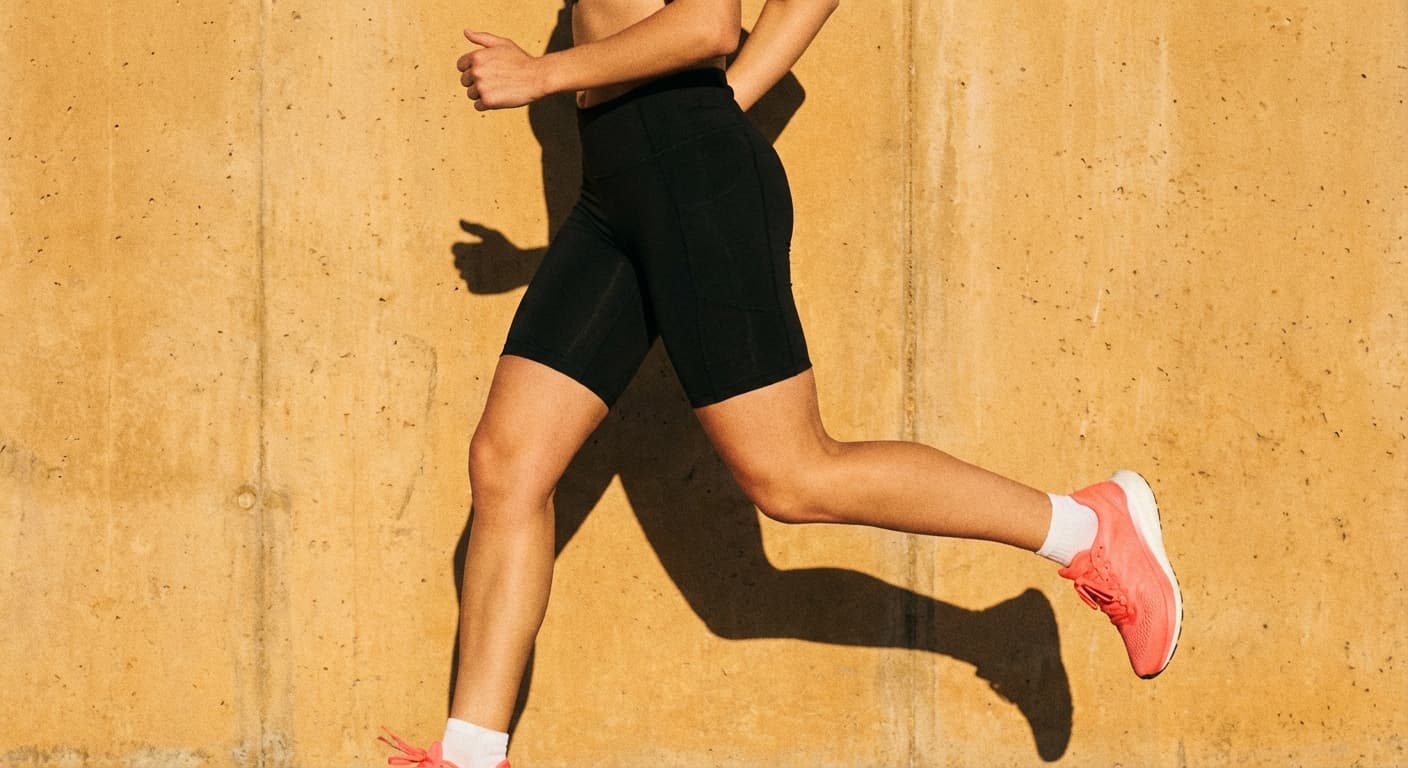
Running form is one of those topics that can make you feel like you need an engineering degree just to put one foot in front of the other. Forefoot strike or heel strike? High knees or low knees? Arms at 90 degrees or 45?
Take a breath. It's simpler than the internet makes it sound.
Your body is built to run. You don't need perfect form to run safely and enjoyably. But a few small adjustments can make your runs feel dramatically easier and keep you injury free. Let's go from head to toe.
Head and Eyes
Look ahead, not down. Your gaze should be about 15 to 20 feet in front of you, not at your shoes. When you stare at the ground, your head drops forward, your shoulders follow, and your whole posture collapses.Think of it like driving. You look at the road ahead, not at the hood of the car.
Your chin should be level, not tucked into your chest and not jutting forward. Imagine a string gently pulling the top of your head toward the sky.
Shoulders
The most common form issue for women (and men) is tense shoulders. You're running along, thinking about your pace, your breathing, your grocery list, and without realizing it, your shoulders have crept up to your ears.
Relax them. Drop them down and back. Let your arms hang for a second, shake them out, then settle into a relaxed position.A good cue: every 10 minutes during your run, do a quick body scan. Forehead relaxed? Jaw unclenched? Shoulders down? Good. Keep going.
Arms
Your arms set the rhythm for your entire body. Get them right and your legs follow.
Bend at 90 degrees. Your elbows should be at roughly a right angle, with your hands loosely cupped. Not clenched into fists. The classic cue is to imagine holding a potato chip in each hand without crushing it. Swing forward and back, not across your body. If your hands cross the center line of your chest with each stride, you're wasting energy on rotation instead of forward motion. Think of your arms as pistons driving you ahead.Keep your hands relaxed. If your hands are tight, your arms are tight. If your arms are tight, your shoulders are tight. Tension travels up the chain.
Core and Posture
Your core is the connection between your upper body and lower body. It doesn't need to be flexed like you're doing a plank, but it should be gently engaged. Think "tall" rather than "tight."
Lean slightly forward from your ankles, not your waist. This forward lean uses gravity to help pull you ahead. But the lean comes from your ankles, not from bending at the hips. If you're hunching forward, you're doing it wrong.Imagine a straight line from your ankle through your hip, shoulder, and ear. That's your running posture. Tall, aligned, slightly forward.
Hips
Your hips are your engine. They should be level and stable, not dropping side to side like a pendulum.
Run tall. The most common hip issue is "sitting back," where your hips tuck under and you're essentially running from a slight squat position. This kills your power and strains your lower back.Push your hips slightly forward. Feel like you're being gently pulled by a rope attached to your belt buckle.
Feet and Footstrike
This is where the internet gets really loud, and most of what you'll read doesn't matter for recreational runners.
Land with your foot under your center of gravity, not out in front of you. That's the important part. When your foot lands way ahead of your body (overstriding), it acts like a brake with every step. It's inefficient and it's the leading cause of shin splints and knee pain.Whether you land on your heel, midfoot, or forefoot matters much less than where your foot lands relative to your body. Most recreational runners are heel strikers, and that's completely fine as long as you're not overstriding.
The simplest fix: take slightly shorter, quicker steps. This naturally brings your footstrike under your body.
Cadence
Cadence is how many steps you take per minute. Most coaches recommend aiming for 170 to 180 steps per minute for efficient running.
If you're a beginner, your cadence is probably around 150 to 160. You don't need to force it to 180 overnight. Just gradually increase by 5% every few weeks. A simple way: find a playlist with songs at 170 to 175 BPM and match your steps to the beat.
Higher cadence means shorter, quicker steps. Shorter steps mean less impact per step. Less impact means fewer injuries. It's one of the simplest changes with the biggest return.
What Women Should Know About Form
Women have a wider pelvis than men, which creates a slightly larger Q-angle at the knee. In plain English: your thigh bone angles inward more from hip to knee, which can cause your knee to track inward when you run.
This isn't a flaw. It's anatomy. But it means that hip and glute strengthening is especially important for women runners. Weak glutes allow your knee to collapse inward, which leads to IT band pain, runner's knee, and other common injuries.
Three exercises that fix this (do them 2 to 3 times per week):
- Clamshells. Lie on your side, knees bent. Open your top knee like a clamshell while keeping your feet together. 15 reps each side.
- Single leg bridges. Lie on your back, one foot flat. Push your hips up. 10 reps each side.
- Side steps with a band. Mini band around your ankles, squat slightly, step sideways. 15 steps each direction.
The One Form Fix That Matters Most
If you only change one thing about your form, make it this: don't overstride.
Shorter, quicker steps solve most form problems automatically. Your foot lands under your body instead of ahead of it. Your cadence increases. Your impact decreases. Your efficiency improves.
Everything else (arm swing, posture, breathing) can be refined over time. But if your footstrike is in the right place, you're 80% of the way to good form already.
Common Questions
Does running form really matter?
For preventing injuries and running more efficiently, yes. For enjoying running and finishing races, it matters less than you think. Don't let form anxiety stop you from running.
Should I switch to forefoot running?
Probably not, unless you have a specific reason. Forcing a forefoot strike when your body naturally heel strikes can cause new injuries (Achilles issues, calf strains). Run however feels natural, and focus on landing under your body.
How do I know if I'm overstriding?
If your foot lands noticeably ahead of your knee when it hits the ground, you're overstriding. Have someone film you from the side at a normal pace. The visual makes it obvious.
Do I need to think about form the whole run?
No. Check in every 10 to 15 minutes, make quick adjustments, and then let your body do its thing. Form becomes automatic with practice.
Good form is a practice, not a performance. The more you run, the more natural it becomes. And the occasional body scan mid-run is all you need to keep things in check.
Take the quiz and get a coach who helps you build strong form from day one.