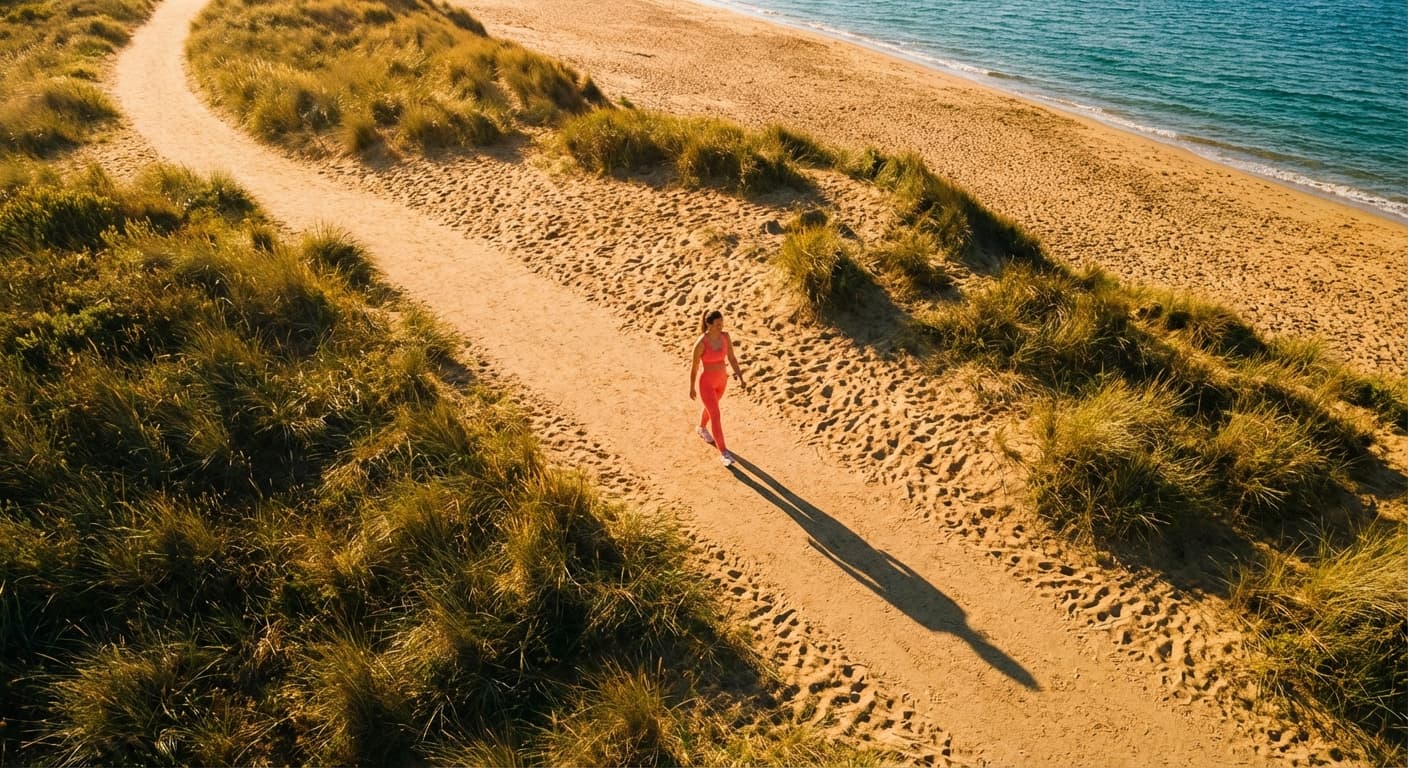
If you're staring at your step counter wondering what that number actually means in real life, you're not alone. The 10,000 step goal has become the universal benchmark for daily movement, but nobody ever explains what it actually looks like.
So let's break it down. Simply. No jargon, no guesswork.
The Short Answer
10,000 steps is approximately 4.4 miles (7.1 kilometers) for the average woman. That's roughly the distance of walking from your home to a coffee shop about two miles away and back, with a small detour.But here's the thing: your number might be slightly different. Your height, stride length, and whether you're walking or running all change the math. Let's get specific.
10,000 Steps to Miles by Height
Your stride length is the biggest factor. Taller women take longer steps, so they cover more ground per step. Here's what 10,000 steps looks like at different heights:
Walking pace:| Your height | Steps per mile | 10,000 steps = |
|---|---|---|
| 5'0" (152 cm) | 2,371 steps | 4.2 miles |
| 5'2" (157 cm) | 2,316 steps | 4.3 miles |
| 5'4" (163 cm) | 2,252 steps | 4.4 miles |
| 5'6" (168 cm) | 2,197 steps | 4.6 miles |
| 5'8" (173 cm) | 2,140 steps | 4.7 miles |
| 5'10" (178 cm) | 2,083 steps | 4.8 miles |
If you're running, your stride is longer, so 10,000 running steps covers about 5.5 to 6.5 miles depending on your pace.
Tip: Want to calculate your exact distance? Count your steps over 100 meters, divide 100 by that number to get your stride length in meters, then multiply by 10,000. That's your personal 10K-step distance.
How Long Does It Take to Walk 10,000 Steps?
Most women walk at about 3 miles per hour. At that pace, 10,000 steps takes roughly 1 hour and 30 minutes to 1 hour and 45 minutes of total walking time.
But you don't have to do it all at once. That's the beauty of step counting. Your steps accumulate throughout the day from everything you do:
| Activity | Approximate steps |
|---|---|
| Morning walk (20 min) | 2,000 |
| Walking around the office | 1,500 |
| Lunch break stroll (15 min) | 1,500 |
| Errands and shopping | 2,000 |
| Evening walk (20 min) | 2,000 |
| Around the house | 1,000 |
| Total | 10,000 |
You probably get more steps than you think just living your life. A dedicated 30 minute walk fills in whatever gap is left.

How Many Calories Do 10,000 Steps Burn?
This depends on your body weight and pace, but here's a realistic range for women:
| Your weight | Calories burned (walking) | Calories burned (running) |
|---|---|---|
| 130 lbs (59 kg) | ~350 cal | ~520 cal |
| 150 lbs (68 kg) | ~400 cal | ~600 cal |
| 170 lbs (77 kg) | ~450 cal | ~680 cal |
| 200 lbs (91 kg) | ~530 cal | ~800 cal |
To put this in perspective, 400 calories is roughly the equivalent of a large latte and a muffin, or a solid lunch salad. Over a week, that daily 400 calorie burn adds up to 2,800 calories, which is close to a pound of fat.
Tip: If weight loss is your goal, 10,000 steps combined with mindful eating is one of the most sustainable approaches. No extreme diets needed. Just consistent movement and awareness of what you're fueling your body with. Read more about running for weight loss.
Is 10,000 Steps a Day Actually Enough?
Yes. For most women, 10,000 steps a day is more than enough to maintain good health.
The CDC recommends 150 minutes of moderate activity per week, which works out to about 7,000 to 8,000 steps per day. So hitting 10,000 puts you comfortably above the minimum.
Recent research published in JAMA Internal Medicine found that women who walked just 4,400 steps per day had significantly lower mortality rates compared to those walking 2,700 steps. The benefits kept increasing up to about 7,500 steps, after which the gains leveled off.
So if 10,000 feels like a stretch, know that 7,500 is genuinely great. And if you're already hitting 10,000? You're doing amazing.
How to Actually Hit 10,000 Steps
If you're currently at 3,000 or 5,000 steps and 10,000 feels far away, don't try to jump there overnight. Add 1,000 steps per week until you reach your goal. Here's what works:
Small wins that add up:- Take phone calls while walking (easy 1,000+ steps)
- Park at the far end of the lot
- Walk to a coworker's desk instead of messaging
- Take the stairs every time
- Add a 15 minute walk after dinner (this one habit alone can transform your step count)
- Walk while waiting for your kids at practice
I started with 4,000 steps and thought 10,000 was impossible. Three months later I hit 12,000 without even trying. It just becomes part of how you move through the day.

From Steps to Running
If you've been consistently hitting your step goals and you're curious about running, you're already in better shape than you think. All those steps have built a base of fitness that makes the transition to running much smoother.
A walk to run program starts exactly where you are. You alternate walking and jogging in small intervals, gradually increasing the running portions. Most women can go from walking to running a full mile within three to four weeks.
If that sounds like your next step, here's our guide to starting running as a beginner. No pressure. Just an option for when walking starts to feel easy and you want a new challenge.
Quick Reference
- 10,000 steps = approximately 4.4 miles for the average woman (5'4")
- Time: about 1.5 hours of walking total (doesn't have to be continuous)
- Calories: roughly 350 to 450 burned, depending on your weight
- Health verdict: exceeds CDC recommendations. You're doing great.
More Step Guides
Curious about other step counts? We've got you covered:
- How far is 5,000 steps? (a solid starting point)
- How far is 7,000 steps? (the research-backed sweet spot)
- How far is 12,000 steps? (above average territory)
- How far is 14,000 steps? (you're in the top 10%)
Common Questions
How many miles is 10,000 steps?
About 4.4 miles for a woman of average height (5'4"). Taller women will cover slightly more ground, shorter women slightly less.
Is 10,000 steps a day good for weight loss?
It's a great foundation. Combined with balanced nutrition, 10,000 steps creates a meaningful calorie deficit that supports steady, sustainable weight loss of about 0.5 to 1 pound per week. More on running for weight loss.
Does running count toward my steps?
Absolutely. Running steps count just like walking steps. You'll actually cover more distance per step when running, so you'll hit 10,000 faster.
How accurate is my phone's step counter?
Reasonably accurate for most purposes. Phones tend to undercount by about 5 to 10%, so if your phone says 10,000, you've likely taken even more. A fitness watch or dedicated pedometer is more precise but not necessary.
What if I can't reach 10,000 steps?
That's completely fine. The research shows major health benefits starting at just 4,400 steps. Any increase from where you are now is a win. Start where you are, not where you think you should be.
Where did the 10,000 step goal come from?
It originated from a 1965 Japanese marketing campaign for a pedometer called "manpo-kei" (literally "10,000 steps meter"). It stuck because it's a nice round number, but the science shows meaningful health benefits start much lower, around 4,400 to 7,500 steps.
Your steps add up. Every walk counts. And if you ever want to turn some of those steps into running strides, your coach is ready when you are.