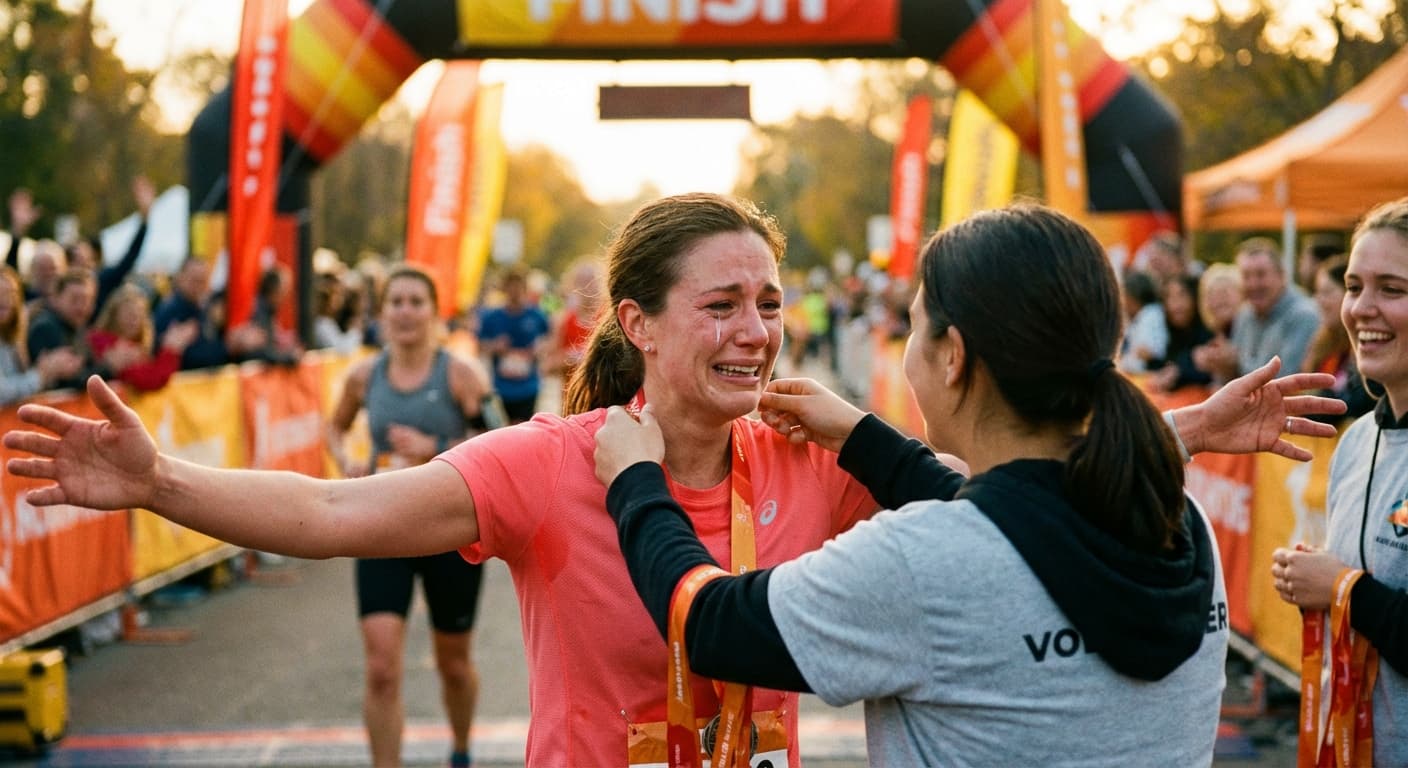
Running a marathon is a life-changing experience. But before the starting gun, you probably want to know: how long is this going to take?
Average Marathon Times for Women
| Age group | Average finish time | Average pace |
|---|---|---|
| 20 to 24 | 4:22 | 10:01/mi |
| 25 to 29 | 4:28 | 10:15/mi |
| 30 to 34 | 4:31 | 10:22/mi |
| 35 to 39 | 4:34 | 10:29/mi |
| 40 to 44 | 4:37 | 10:36/mi |
| 45 to 49 | 4:44 | 10:52/mi |
| 50 to 54 | 4:55 | 11:17/mi |
| 55 to 59 | 5:08 | 11:47/mi |
| 60 to 64 | 5:24 | 12:23/mi |
| 65+ | 5:48 | 13:18/mi |
The overall average marathon time for women is approximately 4 hours and 35 minutes, based on Running USA data across major US marathons.
Benchmarks by Level
| Level | Time range | What it means |
|---|---|---|
| First-timer | 4:30 to 5:30 | You finished 26.2 miles. You're a marathoner. |
| Intermediate | 3:45 to 4:30 | Structured training, consistent effort. |
| Advanced | 3:15 to 3:45 | Speed work, high mileage, serious racing. |
| BQ (age 18-34) | Under 3:30 | Boston qualifying. Top ~10% of women. |
| Elite | Under 2:45 | Professional or near-professional level. |
Your First Marathon: What to Expect
Finishing is the goal. Full stop. Your first marathon is about covering the distance, not about time. The experience of running 26.2 miles teaches you more about yourself than any training plan can. The wall is real. Around mile 18 to 22, many runners hit "the wall" where glycogen stores deplete and everything feels impossibly hard. Proper fueling during the race (gel or fuel every 45 minutes) significantly reduces the wall's impact. You'll probably run a negative split if you're smart. Start 15 to 30 seconds per mile slower than your goal pace for the first 10 miles. The discipline to hold back early pays massive dividends in the final 10K. The last 10K is a different race. Miles 20 to 26.2 are where the marathon actually begins. Your training, your nutrition, and your mental toughness all get tested here. Walk breaks are not failure. They're strategy.How Times Improve Over Multiple Marathons
Most runners improve significantly between their first and second marathon. First-time marathoners typically run 10 to 20 minutes faster in their second race simply because they understand pacing, fueling, and tapering better.
After 3 to 4 marathons, improvement requires more deliberate training: higher weekly mileage, structured speed work, and race-specific preparation.
Common Questions
What is a good time for a first marathon?
Any time is a good time for a first marathon. If you want a numeric benchmark, finishing between 4:00 and 5:00 puts you right in the average range for women.
How long does it take to train for a marathon?
16 to 20 weeks of structured training, assuming you can already run 3 to 6 miles comfortably. Starting from scratch requires building a base first (add 12 to 16 weeks).
Is it OK to walk during a marathon?
Absolutely. Many experienced marathoners walk aid stations, walk steep hills, and use run/walk strategies. Jeff Galloway's run/walk method has helped thousands of runners finish marathons with great times.
What's the slowest acceptable marathon time?
Most major marathons have a 6 to 7 hour time limit. If you finish within the cutoff, you're a marathoner. Period.
26.2 miles. Regardless of the time on the clock, crossing that finish line changes something inside you.
Take the quiz and get a marathon training plan that's built for your pace and your life.